

← Portfolio · ← Collaboration 2.0
2.1 · A new lens — the organization as a complex system
The hinge. 1.1 and 1.2 produced a model. This page names the lens that makes the model usable, and turns it into rules. Every design choice in 2.2–2.6 answers to them.
Sub-sections: 2.1.1 Why complex systems · 2.1.2 Framing · 2.1.3 From a model to a point of intervention
2.1.1 · Why complex systems?
The idea of thinking of the organization as a complex system earned its place in my mind at one specific moment. I expected the regress in 1.1.3 to reach a bottom. It did not. I kept arriving back at symptoms I had already written down while following a different one.
As a piece of method, that is a failure. I set out to find the end of a chain and could not.
Read through a systems lens, on the contrary, it is a finding. A causal chain that will not end, in a system made of people, is a circuit that feeds itself — and people who study such systems already know how those behave. The lens did not find anything new. It let me see what I had already found.
The rest of this section sets out how I read the company. It has three layers: superstructure, structure and infrastructure. Its large properties, from culture through to business results, are made by the people inside it acting on one another.
2.1.2 · Framing — the organization as a complex system
This is not the place to review the concepts and theories of complex systems from the start. So in this section I will name a few of its features, and make clear how the frame applies to the company. The following three ideas are the ones that kept coming to mind during this project.
Sociocultural stratification
Following the cultural-materialist model — Marvin Harris, Cultural Materialism: The Struggle for a Science of Culture (Random House, 1979) — a society, or an organization, is read in three layers: infrastructure (material — production, resources, headcount), structure (behavioural — rules, hierarchies, formal organization), and superstructure (abstract — beliefs, values, norms). The operative claim is that an element at any layer can act on any other layer, in either direction.
I use Harris as a tool for thinking, not as a claim about how societies really are. Other anthropologists dispute cultural materialism, and nothing here depends on settling that argument.
The model licenses the central move of the whole proposed intervention:
- you can change a culture or a belief by changing a process, because structure acts upward on superstructure. Culture is not only a cause. It is also an effect — and effects are the ones you can reach.
- you can change the macro metrics of how the whole organization functions by changing a process and a culture.
A plain example of the same claim. You can advise people to drive slowly on a road, and the advice will not change how they drive. Put speed bumps in the road and they have to drive slowly. After a few years the slow driving is simply how that road is driven, and nobody remembers any more that the bumps were the reason.
That is the direction the whole intervention runs in. Culture is the motor driving individual behaviour. Structure is the bump in the road that reshapes the pattern of driving.
This view tells us that macro-level variables cannot be commanded directly, because they are shaped by the dynamics of many individuals interacting with each other under the conditions of their environment. So if you want one of those higher-level variables to reach the value you want, you have to intervene where those dynamics and interactions actually happen.
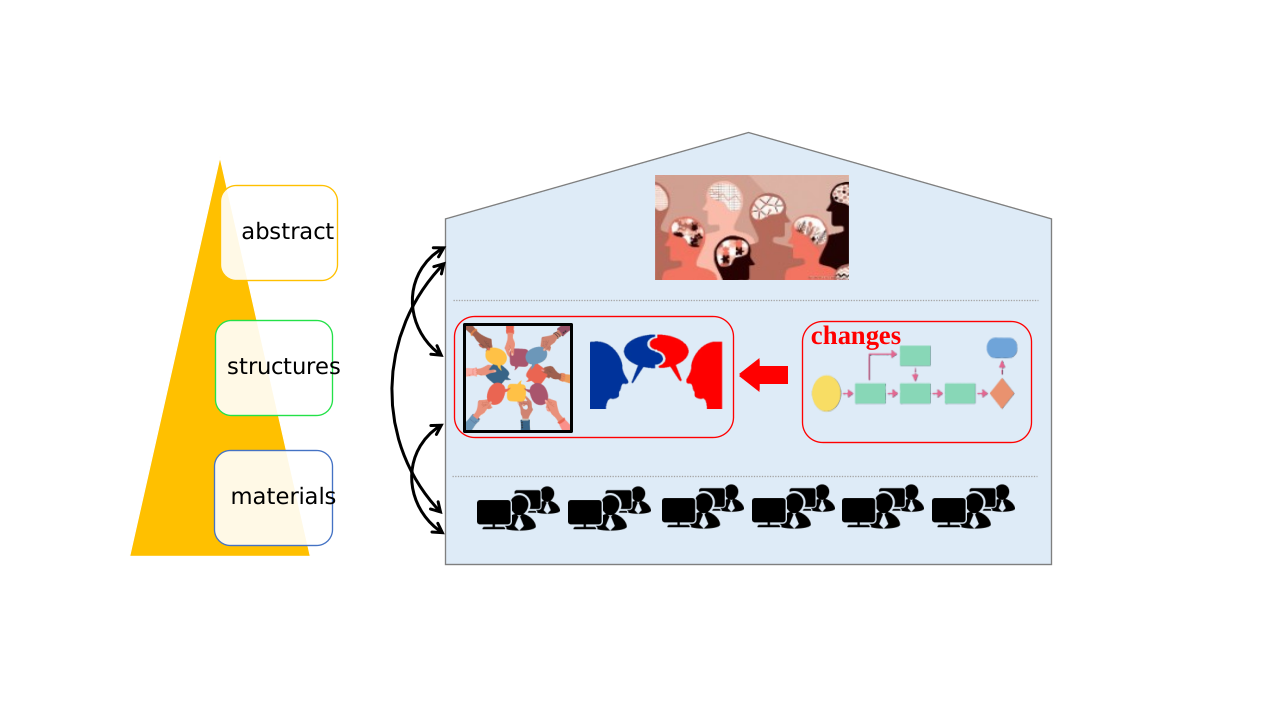
Figure 5 — the three layers, and which way things travel between them. Infrastructure is what the organization is made of: people, money, equipment, output. Structure is what it does: rules, reporting lines, who decides what. Superstructure is what it believes: norms, values, what counts as normal here. Any layer can act on any other, in either direction. The arrow this project rides on is the one going up from structure to superstructure — change what people have to do, and what they believe follows.
Self-organization
A large pattern that stays steady even though nobody is steering it. It stays steady because the parts keep acting on each other in the same way.
The source analysis works two cases through.
In a forest, the share of ground that stays wooded settles at a level. What sets that level is how easily a fire starts in one spot, and how easily it spreads to the next.
In a market, the price settles. What sets it is what buyers and sellers do with each other, one trade at a time.
In both, you reach the number you want by changing what the parts do to each other. You never reach it by naming the number.
The awkward half of this idea is that the division already had a pattern of exactly that kind running. It was simply the wrong one. Figure 3 (1.1.5) draws it.
These problems keep each other alive. There is no single first cause you can remove.
When decisions are made only at the top, people below have little reason to take part. When few people take part, getting your view accepted matters more than having good evidence for it. When that happens, telling people what you actually know becomes a career risk — so people stop telling them.
Now leadership can see less than anyone else in the building. And that is the usual reason given for keeping decisions at the top.
The loop keeps itself running by producing its own excuse. Nobody maintains it and nobody can be held to account for it, which is why every reorganization aimed at it slid off.
The survey found the first turn of that loop still running. People were still putting ideas forward, and half of them named the sense that the decision had already been taken somewhere above as the reason it went nowhere (4.3).
So the design problem is not to bring self-organization into a company that has none. It is to start a second pattern, a useful one, on the same people and the same daily work, and let it compete with the one already there.
Emergence
Patterns appear that nobody planned, and that you could not have worked out from the parts on their own. The cleanest social example is a language. No one decides how it drifts, and yet it drifts the same way for everyone who speaks it.
Put the three ideas together and you get one position. The whole design rests on it.
Accountability, transparency and the use of what people know are not things you can order. Tell an organization to be accountable and you get the appearance of accountability, which is worse than none, because it is harder to see through.
The variables you do have control over are much smaller: who has to be in the room, what has to be written down, and who gets to see it.
2.1.3 · From a model to a point of intervention
What the diagnosis handed over is four things, each established elsewhere and not re-argued here:
- Three symptom clusters — hierarchy and structure, culture and norms, strategy and market (1.1.5, Figure 3).
- Four routes between them, which is what turns three local problems into one circuit (1.1.5).
- Two enabling conditions, which are history rather than machinery, and cannot be removed (1.2, Figure 4).
- Capability was present — about half the technical staff of that period now hold jobs the international market competes for (4.1).
The clusters are the pattern. The routes are what people keep doing to each other that holds the pattern still. The two conditions are the history that let it settle where it did.
Only the routes are still happening. That is the whole reason the intervention has anywhere to land.
Why the regress could not give me a target. There are several mistakes in the conclusion that removing the root uproots everything the root caused. Here is the one that matters.
The root of the symptoms is the patient itself. In our case the company was where the root of the problem was hardcoded. Can we think of an intervention that suggests killing the patient, and then all the symptoms will be gone?
You cannot cure a patient by killing them. So the regress, followed honestly, hands you a root you are not allowed to touch.
The systems lens gets past that, by asking a different question about the same picture.
Question A: what keeps this going now?
Question B: what had to be true before, for something like this to start — and to survive once it had started?
The regress loops because it only ever asks A. In a circuit that feeds itself, every answer to A is another part of the circuit. So you go round again.
B cannot loop. It asks about conditions rather than about causes, and the conditions sit outside the picture instead of inside it. That is what Figure 4 draws, and it is why Figure 4 is a tree while Figure 3 is not. The two figures answer two different questions. They are not two answers to the same one.
This moves the target. Stay with A and you look for the one part to remove, and there is not one. Ask B and you get something better than a part. You get the things people keep doing to each other that make the pattern.
A history cannot be rewritten, and an authority structure cannot be rebalanced by me. But what people do to each other can be written down, and changed.
So where does the intervention go? I did not work from the symptom list. I went to the edges in Figure 3 — the ones that carry a failure out of one cluster and into another. For each edge I asked two questions. What is it actually made of? And what would stop it carrying?
Three answers came back. Each one became something the new process had to supply.
- Most of those edges are made of secrecy. The loop runs because what people know stays where they are. So the process puts the document, and everything that happened to it, in front of everyone by default. You do not argue the edge down. You starve it.
- The strategy-and-market crossings run on nothing being written down. Goals nobody can act on travel along them. So does work with no visible point. Both travel because nothing forces the market people and the engineers into the same room at the same time. A PRD is that thing. It makes a loose crossing stiff.
- Openness cuts both ways, and I wanted both ways. It reaches the capable people whose knowledge the company was not using — the ones 4.1 counts. And because a contribution is on the record, responsibility comes with it. Asking for a feature stops being a free opinion. It becomes a claim about the product with your name on it.
A small rule only moves a large pattern if it fires often, binds everyone, and sits on the connections the graph actually runs on. A rule that fires rarely leaves the pattern alone. So does a rule only some people have to follow.
One more thing follows from the lens, and it is the part organizational work usually skips.
If what you are aiming at is a property of the whole system, you have to say how you will see it before you disturb anything. Afterwards there is nothing left to compare against. That is what 2.6 is for: accountability, communication ratio, time-efficiency, and how much of what people know reaches the decisions it bears on. All four were named in advance.
Naming the measures before you start is what makes this an experiment rather than a proposal.
2.2 is the intervention itself.
⟵ Up: Collaboration 2.0 · Previous: 1.3 · Disclaimers · Next: 2.2 · The approach — Collaboration 2.0 →