

← Portfolio · ← Collaboration 2.0
3.2 · Artifacts
What physically exists from this work. This page is the inventory. The individual items are put in context throughout the document.
| Artifact | Form | Shows |
|---|---|---|
| Intellectual-assets analysis | Coded dataset and results table, reproduced at 4.1 | That the capability question was settled with evidence, not asserted |
| Root-cause analysis and interconnection map | Interactive SVG deck with tree navigation | The diagnosis, and that it was structured |
| Systematic analysis of organizational processes | Presentation, Persian | The complex-systems framing, and obstacle tables with cause/effect cross-references |
| Collaboration 2.0 framework | Presentation, English | The intervention as it was presented internally |
| PRD and its development process | Presentation, bilingual | The process design |
| Product requirement document template, general | Document | The instrument |
| PRD template, condition-monitoring variant (two revisions) | Document | Domain specialisation, and the consensus-signed disclaimer section |
| Role / lifecycle RACI model | Presentation | The responsibility structure — contributed by a teammate — see 2.4.2 |
| Proposed strategy, v2 | Presentation | The 24-month phased plan |
| Market strategy question set | Document | The remedy for the missing market function |
| Introduction letter to leads and management | Document, Persian | The rollout, and the stated non-authority of the system design team |
| Survey instrument | Document, Persian — transcribed to English | The measurement design |
| Survey results and their reading | Analysis, reproduced in full at 4.1 | The baseline measurement, question by question, including the answers that contradict the design |
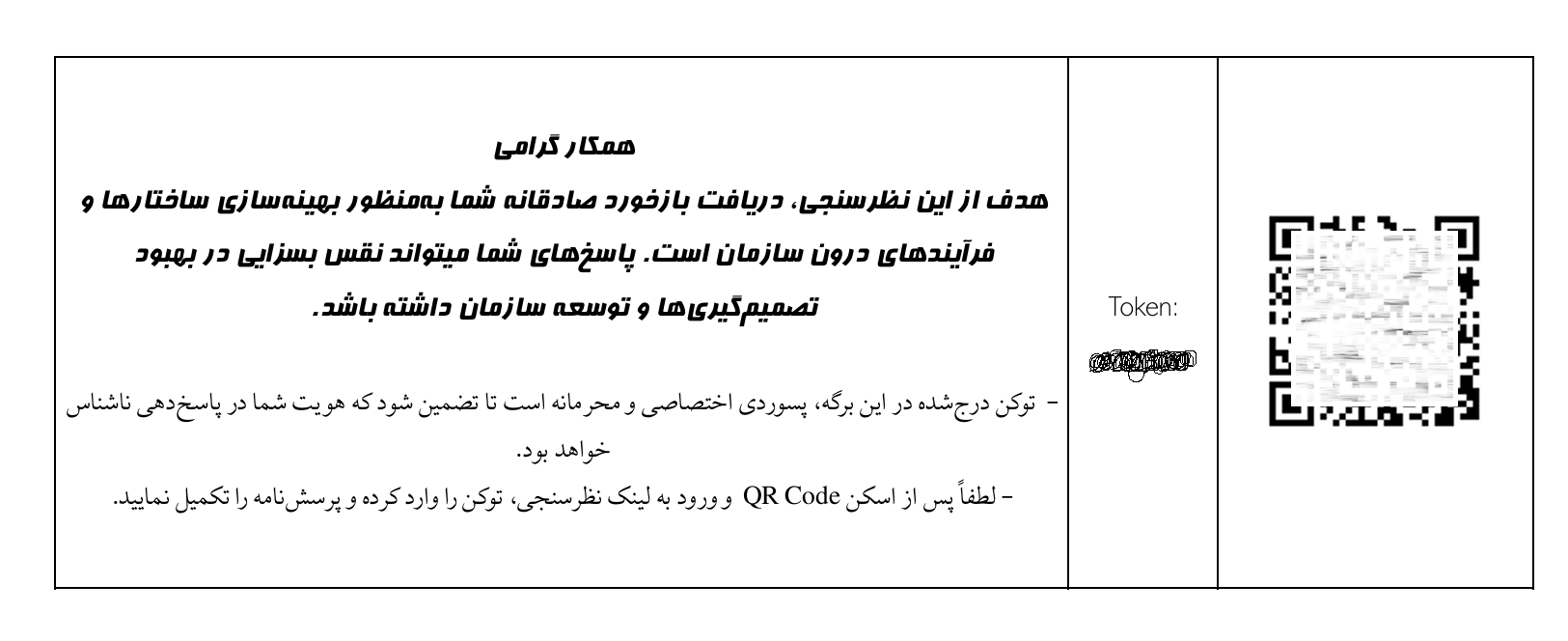
| Printed anonymous token sheets | PDF, print-ready — one sheet, redacted | That it went far enough to be printed |
| Training videos | Video, Persian | The rollout, delivered |
Three rows are reproduced inside this entry: the intellectual-assets analysis at 4.1, the survey instrument, and the survey results at 4.3. 4.1 publishes its population, its coding rule, its results, and the three borderline cases coded against my own interest. Every other row a reader has to take on trust.
Several of these were presented and recorded in Persian.
Scope and attribution
Anonymization. The organization is described by size and sector only. Nobody is named. That includes the intellectual-assets analysis, where the source material names the people who left and where they went; in 4.1 the destinations are reported as categories with counts. No performance figures, financial figures, customer identities or proprietary product details appear anywhere in this entry, and no internal document is reproduced in full.
Attribution. The diagnosis, the framework, the PRD wedge, the authoring process, the survey design and the phased strategy are my own work. The role and lifecycle model in 2.4.2 is a colleague’s contribution, introduced here rather than claimed. Several of the source artifacts are signed “Systems Design and Engineering Team”, of which I was a member and the person responsible for this change; where this document says “we”, that team is who is meant.
What is not claimed. That the intervention succeeded. 3.1 says plainly that it was half executed, and where it stopped.
⟵ Up: Collaboration 2.0 · Previous: 3.1 · Status, outcome and reflection · Next: 4.1 · Evidence — the intellectual-assets analysis →